
Learn about Space
What Is an Asteroid? A Simple Guide for Kids
What is an asteroid? Learn where these space rocks travel, how their sizes differ, and why a near-Earth orbit is not the same as an impact warning.


An asteroid is a natural object, usually made of rock and sometimes metal, that travels around the Sun. It is much smaller than a planet. Many asteroids orbit in the broad region between Mars and Jupiter, but they do not all stay there. That is the short answer to “What is an asteroid?”
Where do asteroids come from?
Asteroids are leftovers from the early Solar System. The planets formed long ago, but not every piece of material became part of a planet. Many of these smaller pieces still travel around the Sun today.
The main asteroid belt lies between Mars and Jupiter. Imagine a very wide stretch of space, not a tightly packed wall of rocks. Other asteroids follow different paths. Some have orbits that bring them into Earth’s part of the Solar System; scientists call those near-Earth asteroids.
“Near-Earth” describes an orbit. It does not mean that an asteroid is about to hit Earth. A predicted close pass and an impact are different things.
Are all asteroids the same size?
No. Some are only a few metres across; others are hundreds of kilometres across. Many are irregularly shaped rather than round like the planets in a picture book. Their material also varies: rock is common, and some contain metal.
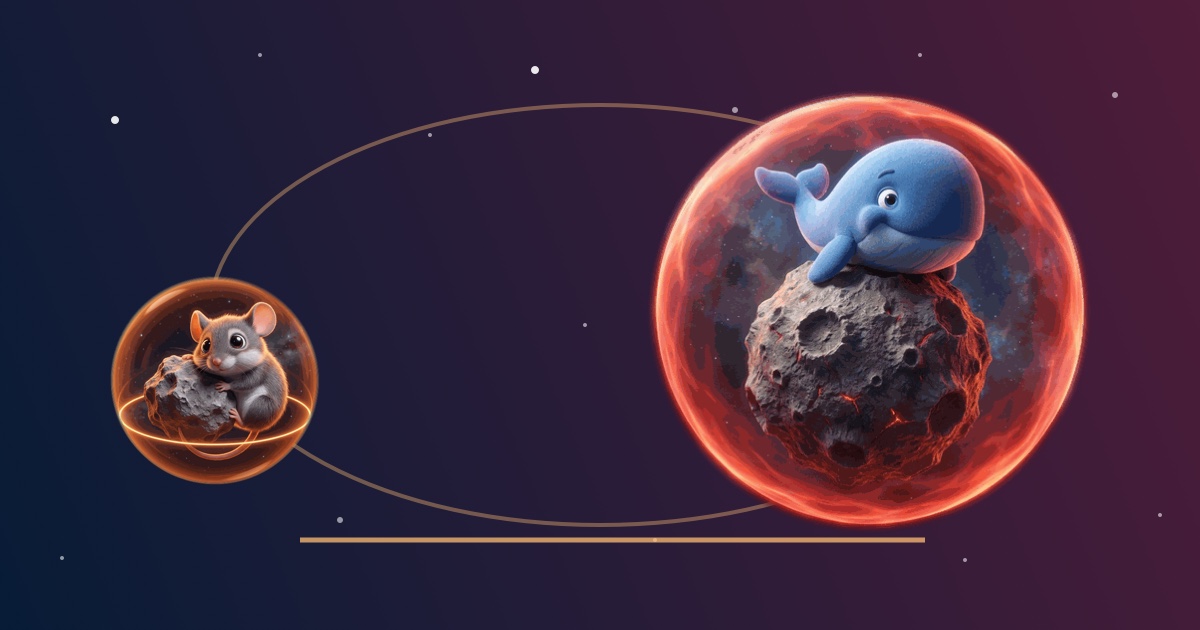
When someone says an asteroid is “small” or “large,” ask what they are measuring. Its size is how wide the object is. Its approach distance is how far it passes from Earth. A small object can pass far away, and a large one can be far away too. The animal characters in Rockimals are a playful comparison, not a photograph or a life-size model of an asteroid.
A calm way to picture a close pass
Here is an imaginary example, not today’s sky data: suppose a visitor is predicted to pass at twice the distance between Earth and the Moon. That number describes the gap between the visitor and Earth. It says nothing by itself about how wide the visitor is, and “close” in space does not automatically mean dangerous.
Try two questions with a child: “How big is the rock?” and “How far away will it be?” Keeping the answers separate makes a space headline easier to understand.
What is real in Rockimals?
Rockimals uses real near-Earth object information for a visitor’s official identity and selected measurements, such as size, approach distance and speed. In the app’s Radar, you can tap a visitor and read its information card. The friendly animal, its name and its story are invented for the game. Niko the mouse is not an official asteroid name or a NASA image.
You do not need the app to learn about asteroids. For a follow-up activity in Rockimals, compare an animal’s illustrated size card with the approach distance in the grown-up facts. Size describes the object; distance describes its separation from Earth. This app example was reviewed for iOS 1.5.0 on 17 October 2026.
Rockimals is an independent app. It uses NASA/JPL space data but is not affiliated with or endorsed by NASA.
Sources
- NASA Space Place: What Is an Asteroid? — child-friendly definition, composition and the asteroid belt; reviewed 22 September 2026.
- NASA Science: Asteroid Facts — origins, shapes, sizes and orbits; reviewed 22 September 2026.
- NASA/JPL Center for Near-Earth Object Studies: NEO groups — what “near-Earth” means for an orbit; reviewed 22 September 2026.
- Rockimals on the UK App Store — Product and version checked 17 October 2026.