
Learn about Space
How Big Are Asteroids? A Size Guide for Kids
Compare asteroid diameters with a bus and football pitch, learn why sizes are estimates, and meet Rockimals' eight size-band animals.


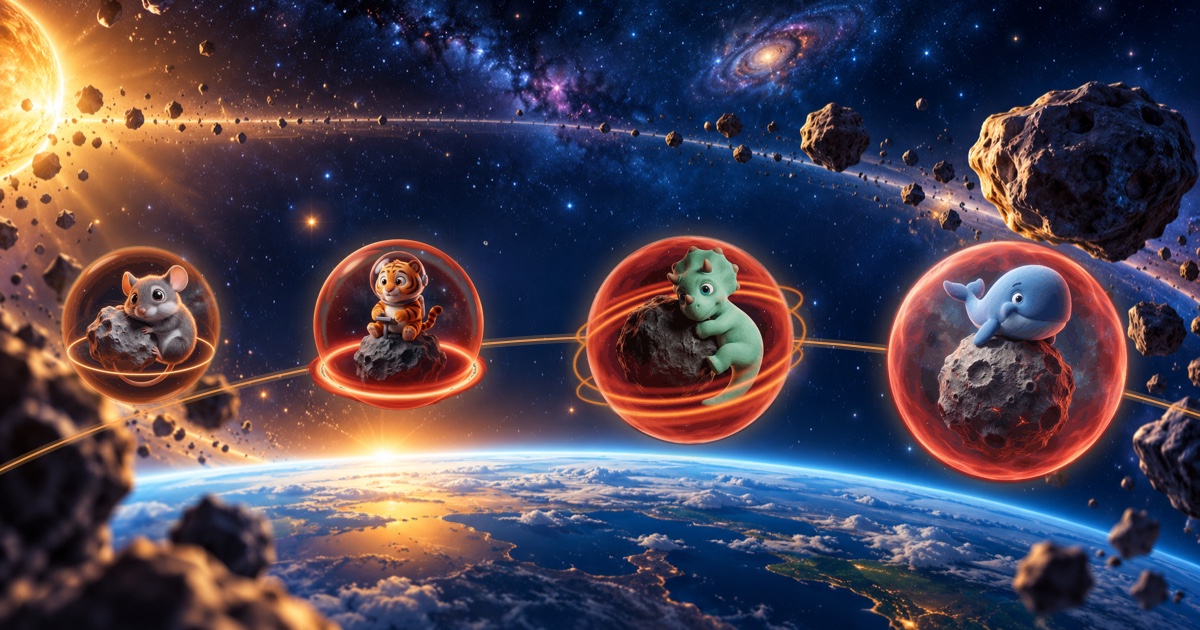
Asteroids come in very different sizes. Some are only a few metres across; others measure hundreds of kilometres. When we ask how big one is, we usually mean its diameter: roughly how wide the body is, not how close it will pass Earth. Many asteroids are irregular rocks rather than perfect balls, so a single diameter is a useful approximation.
Put metres beside familiar things
Imagine a hypothetical 12-metre asteroid beside a bus about 12 metres long. A 100-metre asteroid would stretch roughly the length of a football pitch; an international pitch is usually 100–110 metres long. A 1-kilometre asteroid is 1,000 metres across—about ten 100-metre pitches end to end. These are length comparisons, not pictures of a real visitor or claims that every bus and pitch has exactly those dimensions.
Try drawing a line on paper with 1 centimetre representing 10 metres. The 12-metre example needs 1.2 centimetres; the 100-metre example needs 10 centimetres. The 1-kilometre example would need a whole metre of paper. That is why a phone screen cannot show all three at one faithful scale.
How do scientists know a size?
Some asteroids have been measured more directly, but many size figures are estimates. Astronomers can combine an asteroid’s brightness with an assumption about how reflective its surface is. A dark rock and a bright rock can look equally bright while having different diameters. NASA/JPL’s size estimator therefore shows ranges, not a promise of an exact width. A later observation may change the estimate.
Rockimals’ playful size ladder
In the reviewed 1.5.1 app source, Rockimals uses the upper end of a visitor’s estimated diameter to choose its physical size band and default animal. The boundaries below are in metres; each upper boundary belongs to the next band. An unassigned visitor at exactly 8 metres, for example, defaults to Tavi rather than Niko. A visitor assigned a story character can display a different animal while keeping its factual size band.
| Estimated diameter used by the game | Animal friend | Playful size label |
|---|---|---|
| Under 8 m | Niko the mouse | Car |
| 8 to under 20 m | Tavi the rabbit | Bus |
| 20 to under 50 m | Barney the fox | House |
| 50 to under 120 m | Kito the tiger | Plane |
| 120 to under 300 m | Pofi the bear | Football pitch |
| 300 to under 800 m | Bobo the elephant | Stadium |
| 800 to under 2,000 m | Ciko the dinosaur | Skyscraper |
| 2,000 m or more | Enoli the whale | Mountain |
The labels are friendly categories, not exact dimensions of a car, building or mountain. For instance, our 100-metre example is roughly one pitch long in ordinary speech, yet the default animal for the game’s 100-metre band is Kito, not the “football pitch” Pofi band. The character art and cover are not scaled models of the asteroids.
Open a visitor’s fact card on Radar to read its estimated diameter, then compare sizes in Size Stack. Ask two different questions: “How wide might it be?” and “How far from Earth will it pass?” Rockimals uses real near-Earth visitor data alongside fictional animal friends and stories; it is independent and is not affiliated with or endorsed by NASA. This product mapping was checked against 1.5.1-labelled source on 23 October 2026; Android’s public version was not independently established.
Curious about the Rockimals world? Watch the 30-second English promotional video on YouTube. This animated introduction is not a to-scale asteroid diagram or a recording of gameplay.
Sources
- NASA Science: Asteroid Facts — varied sizes and often irregular shapes; reviewed 23 October 2026.
- NASA/JPL CNEOS: Asteroid Size Estimator — brightness, reflectivity and size uncertainty; reviewed 23 October 2026.
- IFAB Law 1: The Field of Play — international football pitch length; reviewed 23 October 2026.